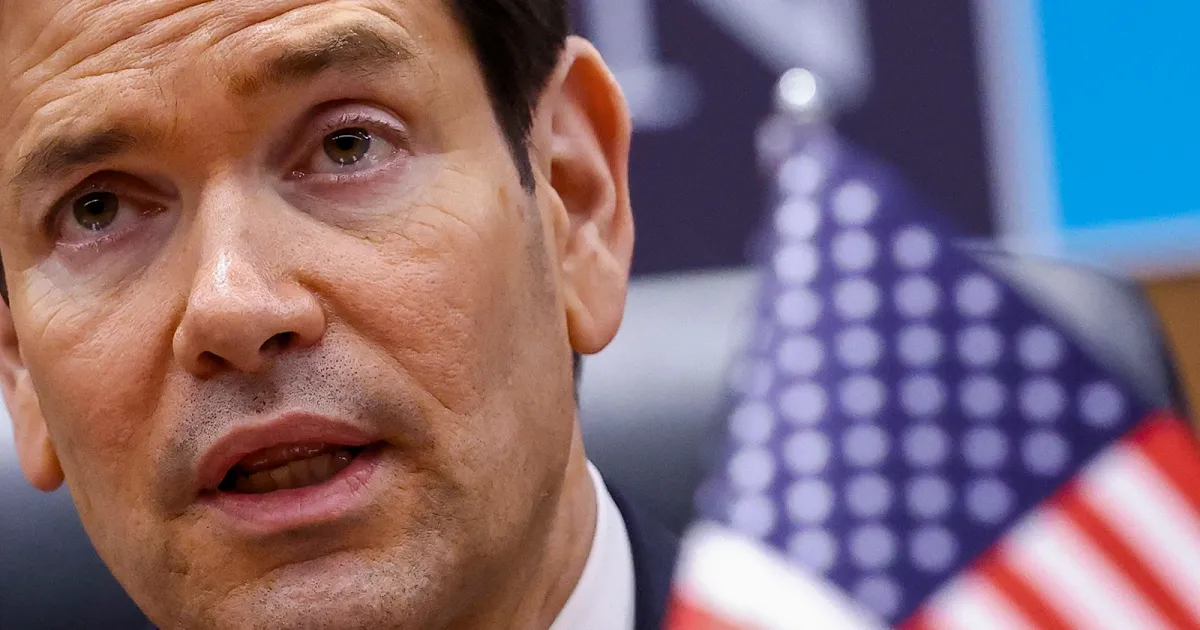
Rubio launches global effort to target left-wing extremists
Secretary of State Marco Rubio will host delegations from 65 countries Thursday for a summit on what the Trump administration describes as a resurgence of far-left political terrorism. Treasury Secretary Scott Bessent and White House deputy chief of staff Stephen Miller are expected to attend.
Read more Facing court losses, Trump turns to prime time to push election conspiracy theories
“Far-left political terrorism is a real and transnational threat that has existed for decades but is now experiencing a resurgence,” Rubio is expected to say in his opening remarks, according to prepared excerpts obtained by MS NOW. “Left-wing extremists operate across borders, maintaining the capability to train, recruit, establish digital infrastructure, fundraise and strike across different countries. The transnational nature of the threat requires an international response.”
Civil liberties groups in the U.S. say they fear that Rubio’s gathering — informally called the “Antifa summit” — is part of the Trump administration’s broader effort to target protesters they view as left-wing extremists.
Daniel Byman, a fellow at the Center for Strategic and International Studies who recently authored a study on political violence from the left and right, said the administration’s focus on violence from the left appeared lopsided.
“We have potential violence from a range of sources, and the extreme right is one of them,” Byman said. “And government should be focused on that just as they’re focused on other concerns.”
A senior State Department official said the event signals the issue’s importance to the United States and that the effort targets violent criminal acts, not peaceful protests or demonstrations.
“For many of our partners and allies, this has been a blind spot, so there are gaps here, and so this is the perfect opportunity for us to address gaps,” the official said.
The State Department said last week that “overwhelming interest”had led it to invite additional countries that are “working to combat the growing international threat of far-left violence.”
Pressed as to why the U.S. is not addressing the threats of both left-wing and right-wing extremism, the official said allies and partners have told U.S. officials that far-left political violence is “a lot more sophisticated” and “more difficult” to counter than far-right violence, which has long been a focus of counterterrorism work.
The summit follows Trump’s counterterrorism strategy, released in May, which listed “violent left-wing extremists, including anarchists and anti-fascists,” as one of three major categories of terror groups America faces. The strategy excluded any mention of far-right violence.
“Our counterterrorism powers will not be used to target our fellow Americans who simply disagree with us,” . “We will not permit the weaponization of America’s unparalleled [counterterrorism] capabilities for partisan purposes.”
Sebastian Gorka, the Trump administration’s senior director for counterterrorism, said in the national counterterrorism strategy that Antifa was one of the groups that would be targeted. Antifa, shorthand for anti-fascist, is not a formal organization but a political movement whose adherents oppose authoritarianism, fascism, neo-Nazism and white supremacy.
Read more Democrats push Trump library to account for millions in lawsuit settlement funds
“In addition to cartels and Islamist terror groups, our national CT activities will also prioritize the rapid identification and neutralization of violent secular political groups whose ideology is anti-American, radically pro-transgender, and anarchist,” the strategy states. “We will use all the tools constitutionally available to us to map them at home, identify their membership, map their ties to international organizations like Antifa.”
Trump signed an executive order in September designating Antifa as a domestic terrorist organization, calling it “a militarist, anarchist enterprise that explicitly calls for the overthrow” of the government and law enforcement while using “illegal means to organize and execute a campaign of terrorism nationwide to accomplish these goals.”
During a White House event in October, Miller said it would be a “valid step” to treat Antifa as a foreign terrorist organization.
In an interview last month, Gorka said Antifa was not being singled out, and that the designation was part of a broader effort against any group that uses violence for ideological reasons.
“Good counterterrorism is very simply a function of using all the constitutional powers we have to identify those who are going to use violence against their fellow citizens for ideological purposes,” Gorka told MS NOW, adding, “be it religious, such as jihadi groups, or be it secular political, such as Antifa or anarchist groups.”
Gorka argued that the U.S. is seeing a resurgence in the left-wing violence of the 1970s, when groups such as the Weather Underground carried out bombings.
“What we witnessed sadly 50 years ago is now back in new forms, whether it’s Antifa, whether it’s radical transgenderism, whether it’s anarchist groups,” Gorka said. “Like Mark Twain said, your history doesn’t repeat itself, but it definitely rhymes, and now the rhyme, the rhythm is left-wing violence is in the ascendance.”
Byman agreed that left-wing attacks have risen, but said left-leaning groups are not as large or organized as they were in the 1960s and 1970s.
“Individuals exist, and you have small groups, people who know each other, but you don’t have these big nationwide organizations,” he said. “You don’t have the Weather Underground.”
Researchers have cautioned against a one-sided focus. A study by the Center for Strategic and International Studies found that 2025 was the first time in more than three decades in which left-wing terrorist attacks outnumbered far-right ones — but noted that the increase came off a very low base and “remains much lower than historical levels of violence carried out by right-wing and jihadist attackers.”
“Right-wing terrorism could come roaring back, especially if in 2028 there are complaints of a ‘stolen election’ or similar incendiary claims,” the study warned, stressing the importance of providing resources to combat terror threats across the political spectrum. “Developing the programs and expertise to suppress different forms of terrorism takes years, and ignoring a long-term threat to go after a more immediate one could be deadly over time.”
Read more Far-right appeals court hands Trump a win in his segregation-enabling crusade











Post Comment