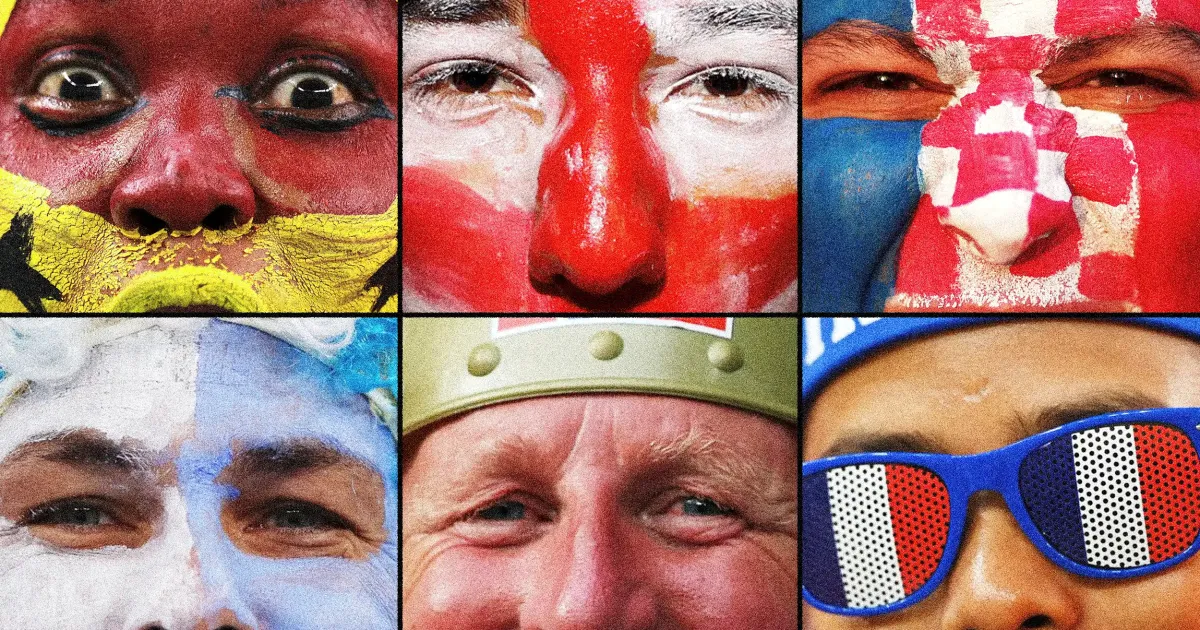
How the World Cup makes it OK for a lot of men to express joy in public
Joy is perhaps one of the most vulnerable things we can experience. It is an unmediated emotion — unlike anger, for instance, which shrouds pain, or even a deep sense of care. And revealing unmediated emotions is incredibly vulnerable.
Read more ‘The Weeknight’ co-hosts sound off on Florida airport renamed after Trump
Hegemonic masculinity does not give men much permission to experience joy and pleasure (in nonsexual contexts) and its concomitant vulnerability: Rarely do we see men giddy. But this FIFA World Cup has given men permission to experience joy and giddiness in a way that is both rare and profound.
As the underdog Norway prepares to take on England in a quarterfinal match in Miami on Saturday, video of Norway fans’ Viking row (both in stadiums and elsewhere, like in Times Square) have been shared and reshared all over the internet.
Every new viral moment evinces this kind of joy. Take, for instance, Scots descending on America in kilts and chanting “No Scotland, No Party” to the tune of The White Stripes’ “Seven Nation Army” wherever they go; and Egyptians dancing in the streets of Vancouver to music, celebrating their team’s win against against New Zealand; Brazilian fans (alongside some Mexican fans) taking a break from celebrating their team’s win against Japan to console a Japanese fan in tears, holding him as he cried and then cheering him up. Then, there’s the Democratic Republic of Congo superfan, who captured the world’s attention by paying homage to the country’s first president, Patrice Lumumba — a crucial figure in the anticolonial, independence movement — posing as an unflinching statue of the politician at Congo matches.
Most of these viral moments of joy and pleasure are predominantly feature men, reflecting the 70%-30% male-to-female split among World Cup viewers in the U.S. and many other parts of the world.
The feeling has been palpable. A friend drew my attention to the rarity of the moment after describing her trip on the T, Boston’s public transit system, throughout which men ran around with flags like superhero capes and vibrated with the excitement and abandon of sugar-addled kids during recess. I felt it as I walked around the city and witnessed throngs of kilt-laden Scots party and dance together. I witnessed it when I watched a match in a sports bar and saw men who started off as strangers become fast friends, putting arms around one another and singing.
Aside from the beauty of joy and pleasure as experiences unto themselves, it is also important to locate these in this broader sociopolitical and ideological landscape. Doing so reminds us that joy is integral to a liberation ethic. (I can think of few things that embody this ethic more than a joyous fan transforming himself into a living statue of Lumumba.)
“What would happen if we aligned with a pleasure politic, especially as people who are surviving long-term oppressive conditions?” author and activist adrienne maree brown asks us in her book, “Pleasure Activism: The Politics of Feeling Good.” She writes, “Pleasure activism is the work we do to reclaim our whole, happy, and satisfiable selves from the impacts, delusions, and limitations of oppression and/or supremacy.”
Pleasure and joy also look very different for those conditioned and socialized as female compared to those conditioned and socialized as male. While the many violences of cishet, white-supremacist patriarchy against women, trans and nonbinary folx are well-documented and rightly foregrounded in conversations about these ideologies, violence against men is generally less widely discussed and explored.
Read more Trump’s disastrous cycle of bad decisions continues as Iran ceasefire collapses
Philosopher bell hooks addresses this lacuna — patriarchy’s impact on men — in her book, “The Will to Change: Men, Masculinity, and Love.” “Patriarchal assault on the emotional life of boys begins at the moment of their birth,” she writes, adding that “patriarchy keeps [men] from knowing themselves, from being in touch with their feelings, from loving.” Ultimately, as hooks notes, hegemonic masculinity leaves little room for men to experience or express anything other than repression, domination (and, relatedly, sexual excitement) or anger.
The vulnerability of expressing an unmediated emotion and the expectations exerted on men regarding emotional expression have resulted in a world that deprives men of opportunities to be joyful — particularly with one another (as male social circles diminish and meaningful male emotional expression is largely reserved for romantic partnerships).
Perhaps the most profound part of joy and pleasure and play is that these feelings necessitate safety. When we are joyful, we are safe enough to let our guard down, to allow ourselves to feel, experience, show and share what is moving through us, to go somewhere unplanned and unrehearsed. The same can be said for play. And, in an increasingly militarized, fascistic and reactionary world, creating conditions in which we can feel safe is both radical and necessary.
Yes, sports are broadly a great container within which men can experience joy — but there are many elements specific to the World Cup that make it singular and amplify these senses of joy and pleasure that feel so palpable. For starters, allegiances in the World Cup are often about national identity (as opposed to the cleavages that form around professional football clubs, for instance), which provide more opportunity for connection and create a more cohesive spectator environment. This is also happening on a global scale, and the fact that it only happens once every four years heightens this sense of giddiness.
To be clear, I do not mean to make the case that the FIFA World Cup is inherently liberatory. As my MS NOW colleague Zeeshan Aleem aptly argued in a piece on the soccer organization’s proposal to pit Palestine against Israel in a youth match, FIFA has a long history of being “eye-wateringly corrupt and politically opportunistic.” This is to say nothing of how the World Cup reproduces and lays bare global inequities in multifarious ways. And sports spectatorship can actually cause more harm interpersonally — an increasing body of research shows correlations between some major sporting events and higher rates of intimate partner violence, especially after a fan’s team loses. There’s also no shortage of examples of sports reinforcing toxic masculinity, such as placing a primacy on physical dominance, or an “in group”/“out group” mentality, which gives rise to other forms of violence.
However, I do contend that this World Cup is also an arena (pun very much intended) within which male joy and pleasure is encouraged and even celebrated. It is a container within which men have the permission to be playful. And there is something revolutionary in this shared experience.
“We must love and care for each other as a radical act of resistance,” hooks writes in another book, “All About Love.” “The struggle for liberation is not simply an intellectual pursuit; it is a physical, emotional, and spiritual battle. Hope grows when we come together as a community, when we lean on each other in our shared struggle, and when we recognize that our collective joy is part of our resistance.”
The FIFA World Cup certainly comes with its own set of complications. But it also fosters a shared — especially male — joy, which is a radical act of resistance, and which we need now more than ever.
Read more Trump fires remaining members of Election Assistance Commission











Post Comment