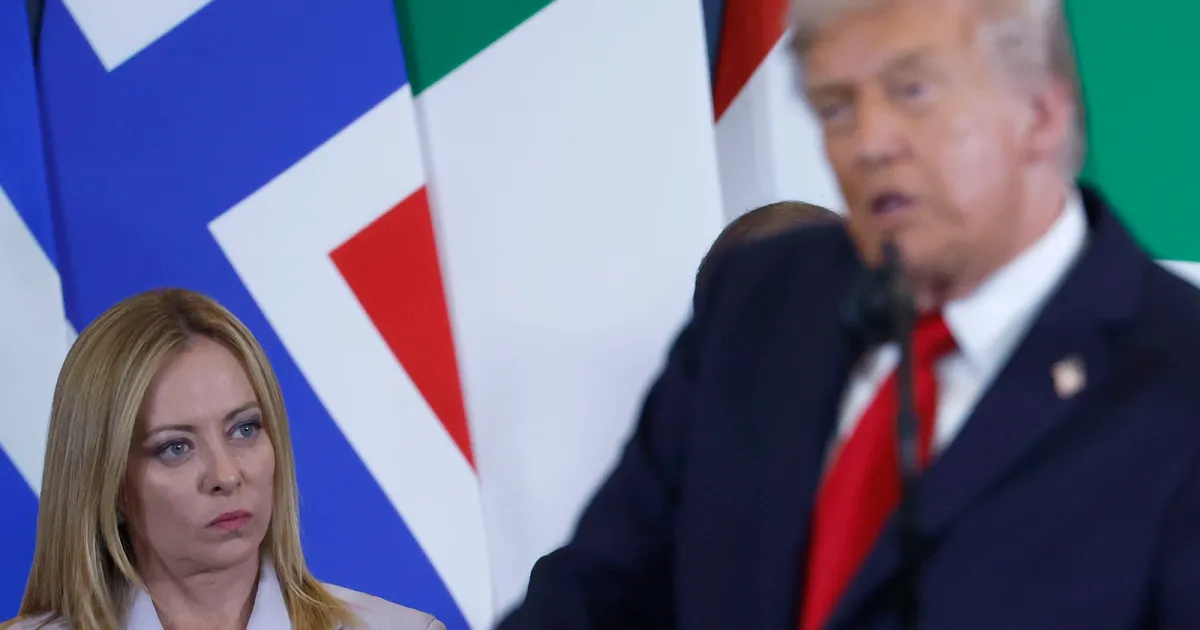
Trump picked a fight with Italy’s Giorgia Meloni. It’s part of a larger pattern.
President Donald Trump is contending with quite a lot on the world stage right now. Europe and NATO are increasingly self-reliant, there’s a quagmire in the Strait of Hormuz as the Middle East realigns without the United States, and the African continent is turning to China for economic development. Yet as the U.S. increasingly goes it alone and loses credibility, its commander in chief insists on projecting his feelings onto a timeworn target of his: women.
Read more Trump administration dangles counterterrorism funding in exchange for voter suppression
The latest recipient of Trump’s sexist ire is Italian Prime Minister Giorgia Meloni, a conservative leader he once praised as a “beautiful young woman” and who was the only European leader to attend Trump’s second inauguration. She fell from his good graces quickly when she defended Pope Leo XIV from his attacks, something any leader in Italy would need to do to ensure their political survival. The spat has continued, with Trump at one point recently posting a photo of himself and Meloni with the caption “restraining order needed” ahead of the NATO conference in Turkey.
Given his track record, the sexism itself should not come as a surprise, but Trump appears to reserve a special type of denigration for women who are leaders of foreign countries. Perhaps it is because protocol requires female heads of state to be treated as peers and equals; perhaps it is because the women leaders he has targeted are, in many cases, popular with their people in a way Trump isn’t. Armchair psychology aside, though, the pattern of his contempt for women leaders is long-standing.
In many instances it seems Trump cannot even be bothered to refer to women leaders he takes aim at by their titles or names, frequently using “this woman” or “this person” as an epithet.
When German Chancellor Angela Merkel was selected as Time magazine’s person of the year in 2015, Trump tweeted about being ignored as “the favorite” for “the person who is ruining Germany.” During a 2016 rally in Iowa, when Germany had agreed to accept Syrian refugees seeking asylum, Trump blamed the woman in charge: “The German people are going to riot … end up overthrowing this woman.”
Trump used a campaign rally in Minnesota to claim that during the Covid-19 epidemic, “there was a big surge in New Zealand” under Prime Minister Jacinda Ardern, despite all evidence pointing to the contrary: that New Zealand under her leadership had one of the lowest case rates in the world.
According to the reporting of veteran journalist Carl Bernstein, Trump will often “fawn over authoritarian strongmen” like Russia’s Vladimir Putin and Turkey’s Recep Tayyip Erdogan, but can be “near-sadistic” in his secure phone calls with women foreign leaders — alarming his national security advisers that relations with allies would be disrupted as a result. Trump’s “most vicious attacks … were aimed at women heads of state,” Bernstein wrote in a 2020 report that cited classified documents and records detailing the president’s official interactions while in his first presidential term.
Read more A horrific NFL story shows brain damage’s terrible toll
In classic Trump rhetoric, the president also often defaults to the male pronoun in press remarks. When asked to respond to comments made by the leaders of Venezuela and Ireland, he consistently responded using male pronouns, making comments like “the Irish president, he is lucky I exist” and, regarding Venezuela, “the relationship with the president is great, we get along with him really well.” (The respective presidents of Ireland and Venezuela, Catherine Connolly and Delcy Rodríguez, are both women.)
For women in power, as with any role in society, there’s no way to win this fight. While Hillary Clinton gamely avoided Trump following her around on the debate stage in 2015, she later regretted not turning around and telling him to back off. Merkel took Trump’s berating her “like water off a duck’s back,” even when he called her “stupid” to her face. Theresa May, as prime minister of the United Kingdom, is said to have become “flustered and nervous” when Trump called her “a fool” for her handling of Brexit and immigration. In each of these instances, Trump thrived in his comfortable role as bully, while women bore the consequences of being targets of his criticism.
As it is to all women working in national security and in leadership, Trump’s sexism is familiar to me. Regardless of the executive titles I’ve earned in places ranging from the White House to academia, or my years of experience as a diplomat, I continually have to prove my credibility to male peers. At one point, a television producer told me point-blank: “You just don’t look like a national security expert.” It gets easier over time to deflect and ignore such microaggressions, like Clinton and Merkel have done.
But perhaps the quips of a younger generation of leaders — women who were not taught to suck it up and carry on when men behaved badly — will be more effective in managing Trump. The record is clear that, whether for a man or woman, being in Trump’s good graces only lasts until he finds something or someone else who will benefit him more.
New Zealand’s Ardern had some success in brushing Trump off and retorting back to him publicly; Meloni started doing the same, and Trump took a milder tone this week. Of course he didn’t use her name or title, but he did call her “a nice person.”
Read more MaddowBlog










Post Comment