How Trump is exploiting the Obama Presidential Center’s precedent
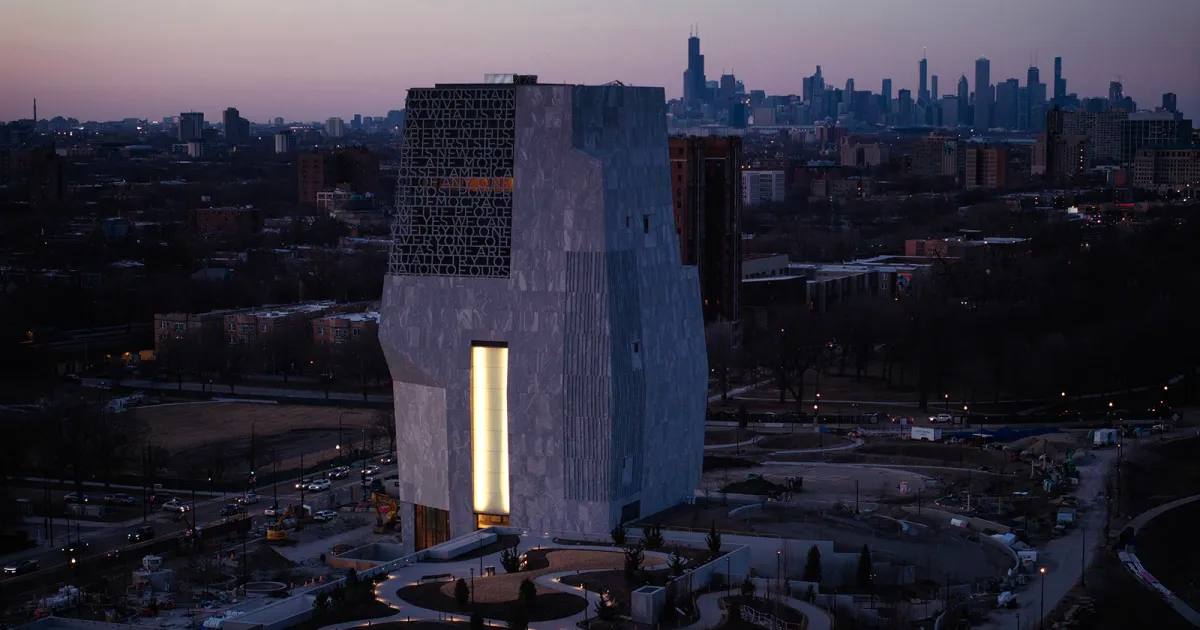
The Obama Presidential Center in Chicago houses many things: the “Obamalisk,” a 225-foot tower that is currently the tallest structure ever featured at a presidential site; a Chicago public library; a massive athletic complex; and a lot more. It was designed as a grand monument to the legacy of America’s first Black president and as a boon to the community that surrounds it. It is not technically, however, a presidential library.
Read more Trump’s obsession is not with the Kennedy Center. It’s with JFK.
Unlike many of its predecessors, the Obama Foundation decided not to officially partner with the National Archives and Records Administration to build a government-run library, with on-site government archives. (It will partner with them on a digitized archive.) This decision was at least partially a financial one. Barack Obama would have been the first president to have to pay NARA 60% of the cost to build the facility as an endowment for future maintenance (prior presidents had to pay just 20%). Since the site ultimately cost $850 million, the foundation would have owed NARA over half a billion dollars.
While perhaps fiscally responsible, the Obama Foundation decision had a secondary, unintended consequence: It likely made it easier for President Donald Trump to justify his own privatized presidential center, which is raising red flags both because of its fundraising tactics and because of the greater control Trump may have over his records than his predecessors.
In late March, Eric Trump, chair of the Trump Presidential Library Foundation, unveiled renderings of a proposed $1 billion, 50-story Miami skyscraper. The affiliated website makes it very easy to donate to the foundation, but there is still no evidence that the president will construct an official library, and Trump himself has said “I don’t believe in building libraries or museums.”
Despite this, ABC News, Paramount, Meta and other large corporations have all donated to Trump’s library foundation so far. The ABC News donation is especially troubling: It was the result of a lawsuit plenty of First Amendment experts have said the company could have fought, raising red flags that have become a recurring theme during Trump’s second term. Qatar “gifted” Trump an extravagant plane, which may ultimately take up residence in the lobby of his presidential center — or hotel — raising obvious concerns about foreign entities and corporations attempting to curry favor through foundation gifts. (My organization, the Freedom of the Press Foundation, has filed a lawsuit to force the release of the secret Justice Department legal rationale justifying the acceptance of the plane despite what appears to be a flagrant evasion of the foreign emoluments clause.)
The fear that these donations represent a quid pro quo is not an abstract concern. Companies that have donated to Trump’s ballroom project have already received a staggering $50 billion in government contracts, and it’s likely that library foundation donors are receiving similar awards.
Unfortunately, we don’t know all the companies that have donated to the library foundation because donation disclosure requirements are almost nonexistent. This secrecy is antithetical to the entire point of presidential libraries.
Presidential libraries were never meant to be temples commemorating the greatness of their namesakes; they were meant to be places where the public can discover the inner workings of presidential administrations through research and the filing of Freedom of Information Act requests. On-site archivists at these facilities help the public and journalists explore everything from presidential diaries to National Security Council memos to records on Supreme Court nominees.
Unfortunately, the hundreds of millions of dollars raised for these facilities doesn’t cover the cost of their maintenance. And none of the money raised through private fundraising goes toward declassifying presidential records. That burden falls entirely on NARA, a federal agency whose budget and staffing has been choked by decades of stagnation and cuts, and whose professional leadership Trump fired and replaced with political appointees with no archival experience.
Read more Michelle Obama’s womanhood isn’t a question. Josh Hokit’s idea of manhood is.
The resulting declassification backlogs are devastating. At the George W. Bush Library in 2024, National Security Archive researchers claimed in court that they faced a staggering 12-year wait for Bush’s phone transcripts with Russian President Vladimir Putin. Worse yet, at current rates, it could take close to 100 years for the Ronald Reagan Library to fully declassify its records.
The Trump Presidential Library Foundation’s fundraising feels especially egregious given his administration’s efforts to eviscerate the Presidential Records Act — the law that requires the preservation of the presidential papers that are stored at presidential libraries.
On April 1 of this year, the DOJ’s Office of Legal Counsel issued a radical opinion declaring the Presidential Records Act unconstitutional. Trump did not contest the constitutionality of the law during his first term despite his obvious disdain for properly preserving government records. It clearly states that presidential records are public property that must be turned over to NARA at the end of an executive’s time in office, and it makes these records available for public inspection through FOIA requests five years after the end of a president’s term.
The White House immediately followed up on that April DOJ memo with a records preservation policy so bad that presidential records risk
That’s why the Freedom of the Press Foundation joined forces with Citizens for Responsibility and Ethics in Washington to sue the administration to preserve its records and affirm the Presidential Records Act’s constitutionality. Fortunately, the guardrails are so far holding: On May 20, a federal judge ordered White House offices to halt their nonpreservation policies.
This ruling is a step in the right direction, but structural fixes to the PRA and the presidential library system are long overdue. Despite long-standing congressional awareness of the problems, lawmakers have let die on the vine.
Legislative fixes such as Democratic Sen. Elizabeth Warren’s Presidential Library Anti-Corruption Act are commendable, but Congress must do more, including aggressively funding NARA’s dying declassification infrastructure and strengthening the records law.
And if we continue to let Trump exploit the Obama Center’s precedent, the American presidential library system could further deteriorate, transforming centers of public knowledge into billion-dollar tombs where the truth goes to be buried.
Read more The U.S. turning away a Somali referee was an awful start to the World Cup



Post Comment